 Invoice Carry
A bathroom can be finished on Friday and still take weeks to pay if the paperwork does not match the work. The customer sees one price in the estimate, another on the invoice, and starts asking what changed. Keep every bill tied to the signed scope, and the money is much easier to collect.
What goes on a contractor invoice?
Put enough detail on the invoice that the customer can tell what job it covers, what you did, and what remains to pay. Make it match the estimate and any approved change orders.
Include your business name and contact details, customer name, job address, unique invoice number, invoice date, due date, and estimate or contract number. List labor, materials, equipment, permits, and approved changes as separate lines when they help explain the price. Show tax if you must charge it, payments already received, the balance due, and how to pay. Include your license number if your state requires it.
Do not send an invoice that only says "Bathroom work, $3,850". Spell out the work instead, for example "Install vanity and reconnect sink, 4 hours" or "Tile, 42 square feet". Specific lines settle questions before they turn into delays.
Our free estimate generator lays out the price before the job starts. Write the scope, what is not included, and the payment stages on it too. The numbers are the easy part. The agreement is what protects you.
How do I write a construction estimate?
Write down the exact work, the materials, the assumptions, and the payment schedule. Price labor by hours and rate, then add material cost and markup in a way you can explain.
Say what is included and what is not. For a bathroom, note whether demolition, disposal, plumbing changes, tile, paint, permits, and fixture installation are part of the price. Add an allowance where the homeowner has not picked a finish. State that hidden damage, such as rotten subfloor found after demolition, needs a written change order.
Here is a small remodel estimate. The numbers are an example, and the tax line assumes this work is not subject to a separately charged sales tax in the job's state. Tax treatment differs by state and by how materials are sold. Check your state revenue department or accountant before copying the tax line.
| Estimate line | Calculation | Amount |
|---|---|---|
| Labor, demo, prep and install | 24 hours x $75 | $1,800 |
| Cement board | 4 sheets x $22 | $88 |
| Waterproofing | 1 kit x $145 | $145 |
| Floor tile | 42 sq. ft. x $8 | $336 |
| Thinset and grout | 3 bags x $28 | $84 |
| Vanity | 1 x $420 | $420 |
| Faucet | 1 x $160 | $160 |
| Materials subtotal | $1,233 | |
| Materials markup | $1,233 x 20% | $246.60 |
| Permit allowance | 1 x $160 | $160 |
| Sales tax in this example | Not charged on this service contract | $0 |
| Estimate total | $3,439.60 |
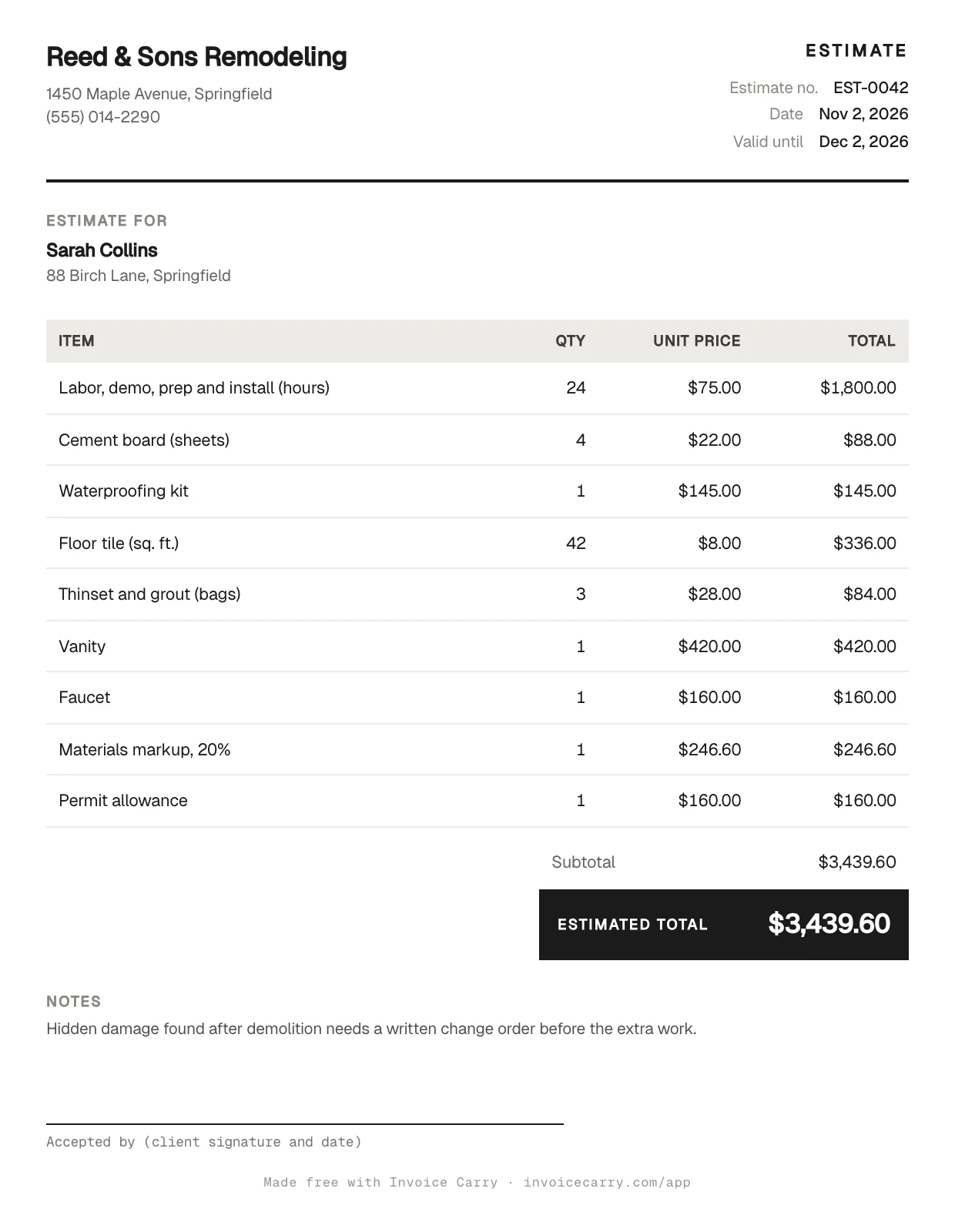
Show labor and materials separately. It helps the customer understand the job and helps you compare actual time and purchases with the estimate. Put markup on its own line if you want it visible, or include it in material prices. Either way, do it the same way every time. The markup calculator shows what a markup turns into as margin.
How much deposit can a contractor ask for?
There is no single deposit rule for every contractor and every job. Several states cap the upfront amount on home improvement contracts, and exceptions apply.
States with a cap we checked in official sources:
- California: generally $1,000 or 10% of the contract price, whichever is less, with exceptions.
- Maryland: the initial deposit is capped at one-third of the home improvement contract price.
- Maine: generally one-third for covered home construction contracts over $3,000, unless the written waiver process in the law is followed.
- Massachusetts: generally up to one-third, or the cost of qualifying special-order materials if that is more.
- Pennsylvania: one-third, plus qualifying special-order materials, for covered home improvement contracts over $5,000.
- Vermont: on contracts with a maximum price, up to half the labor cost or half the price of materials, whichever is greater.
The official sources are linked at the end. Deposit laws can depend on job type, contract size, license status, a bond, or an exception. If your state is not on this list, ask your state's contractor board before you send the estimate.
Our advice: give homeowners "due on receipt" plus a deposit. Keep net 30 for general contractors and property managers. A homeowner does not have a monthly pay run, and an open 30 days is easy to forget. Take a lawful deposit, then collect the rest at clear milestones. A deposit invoice makes the upfront amount its own document.
The worked example below uses a 30% deposit. That is only an example. In California it would be over the limit for an ordinary home improvement contract.
Copy and send this when the customer approves the estimate:
Hi [Name], thanks for approving estimate [Estimate no.] for [Job]. The deposit to book the start date is [Amount], due on receipt. You can pay it here: [Payment link]. I will send a receipt as soon as it is paid.
What documents does one job produce?
Keep one job folder with every signed scope and payment record. Each document has a different job, even if you make them all on your phone.
| Document | What it is for | When to send it |
|---|---|---|
| Estimate | Sets the scope, price, assumptions, and payment schedule for approval. | Before work starts. Get it signed before collecting a deposit. |
| Deposit invoice | Requests the agreed, lawful upfront payment and names the job. | After the estimate is approved and before the start date. |
| Change order | Records added, removed, or changed work, its price, and any schedule effect. | Get it signed before doing extra work. |
| Progress invoice | Bills an agreed stage or completed part of the work, minus prior payments. | At the milestone stated in the estimate or contract. |
| Final invoice | Brings the original price, changes, tax, retainage, and payments together into the final balance. | When the agreed work is complete, before leaving the site. |
| Receipt | Confirms money received and what it was applied to. | As soon as each payment clears. |
What is progress billing and how do I invoice in stages?
Progress billing means you bill in stages as work is completed. Put each stage and its price in the signed estimate, then show the work completed and payments already made on each invoice.
For a bathroom, stages might be deposit, demolition and rough-in, tile and fixture installation, then completion. Do not invoice a stage just because a date arrived. Tie it to work the customer can see. In some states, including California, progress payments cannot run ahead of the work completed or materials delivered.
Here is the full job from estimate to final payment. The estimate total is $3,439.60. The customer approves a change order to add a shower niche for $450. The revised contract total is $3,889.60. Assume no sales tax applies, and assume the 30% deposit is lawful where the job takes place.
| Billing step | Calculation | Amount due |
|---|---|---|
| Deposit invoice | $3,439.60 x 30% | $1,031.88 |
| Change order #1 | Add tiled shower niche, approved before work | +$450.00 |
| Revised job total | $3,439.60 + $450.00 | $3,889.60 |
| Progress invoice at halfway | 50% of revised total is $1,944.80, less $1,031.88 deposit | $912.92 |
| Final invoice | $3,889.60 less $1,031.88 deposit and $912.92 progress payment | $1,944.80 |
The progress invoice brings total payments to exactly half of the revised job price. The final invoice shows the whole revised total, then subtracts the deposit and progress payment. The customer can check the arithmetic without digging through old texts.
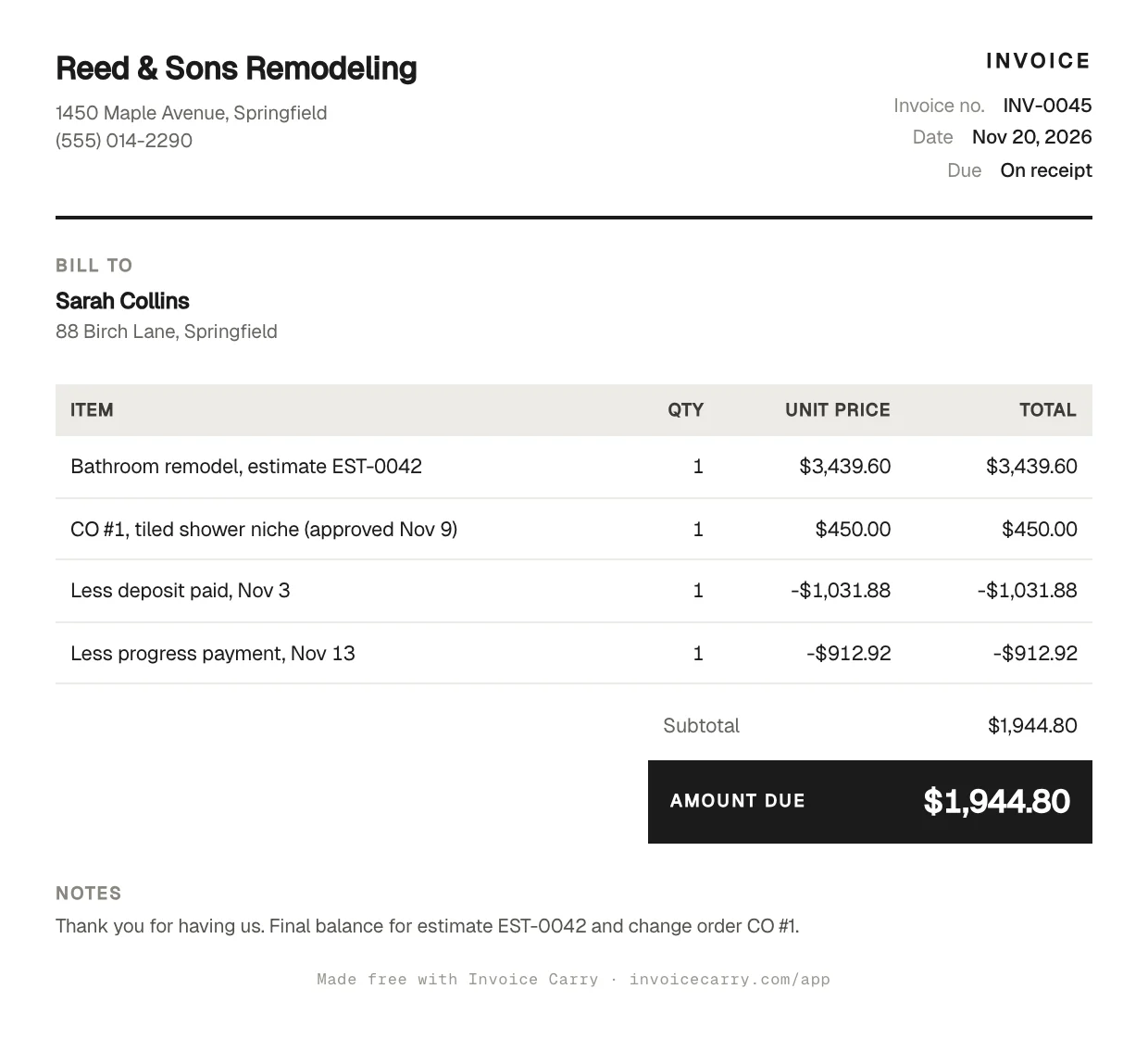
Once the work starts, the signed estimate is the record every invoice is checked against. Invoice Carry lets a client sign the estimate on your screen, and it makes the invoices, estimates and receipts on iPhone and iPad.
How do I handle change orders so the final invoice matches?
Write down each change, its price, and any schedule effect. Get the customer's approval before you do the extra work, then put that same amount on the progress or final invoice.
Do not rely on "go ahead" in a hallway conversation. Take a photo if it helps explain the issue, then send a short change order. In California, the state contractor board says a change to the price or scope of a home improvement contract must be in a written change order signed before the change. Rules differ elsewhere, but written approval protects both sides.
Hi [Name], we found [condition] behind the [area]. The original estimate covers [original scope]. To add [new work], the price is [Amount] and it may add [time] to the schedule. Please reply "approved" or sign change order [CO no.] before we start this extra work.
Do not quietly add the $450 niche to a general "labor" line later. Give it its own change order number, keep the signed approval with the estimate, and list "CO #1, tiled shower niche" on the next invoice.
What is retainage and how do I show it?
Retainage is money held back from a payment until a later job milestone. It is common in some commercial contracts, and the contract should state the amount and when it is released.
For example, if a general contractor holds 10% retainage on a $10,000 progress invoice, the invoice shows $10,000 earned, $1,000 held, and $9,000 due now. The $1,000 becomes due when the release condition in the contract is met, such as final inspection or completion of the punch list. Do not assume retainage is allowed or required on every job. Check your contract and your state's rules.
When should I send the final invoice?
Send it when the agreed work is complete and before you leave the site. Walk the customer through the finished work, point out the balance due, and hand over any receipts or warranty information you agreed to.
The final invoice should show the revised contract amount, approved change orders, tax if it applies, retainage released or held, the deposit paid, progress payments received, and the balance due. If the customer spots a missed line, you can sort it out while you are both standing in the bathroom. You can build it with the free invoice generator.
Hi [Name], the bathroom work is complete. Final invoice [Invoice no.] shows the approved estimate, change order [CO no.], and your payments of [Deposit amount] and [Progress amount]. The balance due today is [Amount]. You can pay here: [Payment link]. Thanks for having us.
Send the receipt as soon as the payment clears. Invoice Carry shows each invoice as paid, part paid or late, and every invoice can carry a way to pay, with no fee from us.
Common mistakes
- Taking a deposit before checking your state's rules. Look up your contractor board's rules and write a payment schedule into the contract that follows them.
- Sending a lump-sum bill with no job reference. Include the estimate number, job address, work stage, and invoice number.
- Doing extra work on a spoken okay. Send the change order and get written approval first.
- Forgetting to subtract prior payments. Show the deposit and every progress payment as credits on the final invoice.
- Mixing materials and labor with no explanation. Separate the lines where you can, and use the same markup method you quoted.
- Guessing on sales tax. Construction tax treatment varies by state, and sometimes by the materials or contract type. Check the state revenue department or your accountant.
- Waiting to send the final bill. Send it while the work is fresh and the customer can see it is complete.
TL;DR
- Write a clear estimate with scope, labor, materials, markup, and payment dates.
- Get each change approved in writing before doing the extra work.
- Bill progress at agreed milestones and credit every payment already received.
- Check your state's deposit and tax rules before using a percentage or a tax line.
Sources
- California Contractors State License Board, Home improvement contract rules, checked November 21, 2026.
- California Contractors State License Board, 2026 Contractors License Law and Reference Book, checked November 21, 2026.
- Massachusetts Office of Consumer Affairs and Business Regulation, Home improvement contract sample language, checked November 21, 2026.
- Maryland General Assembly, Business Regulation §8-617, checked November 21, 2026.
- Maine Attorney General, Home construction contracts, checked November 21, 2026.
- Pennsylvania General Assembly, Home Improvement Consumer Protection Act, checked November 21, 2026.
- Vermont General Assembly, 26 V.S.A. §5509, checked November 21, 2026.
Frequently asked questions
What goes on a contractor invoice?
Include your business and customer details, job address, invoice number and date, estimate or contract reference, itemized work, tax if required, payments received, balance due, due date and payment instructions. Add your license number when your state requires it.
How do I write a construction estimate?
Describe the work and what is not included, list labor hours and rate, materials, equipment, permits, markup, tax if applicable, total price and payment schedule. Get the customer to approve and sign it before you start.
How much deposit can a contractor ask for?
It depends on the state and the kind of job. California generally caps home improvement down payments at $1,000 or 10% of the contract price, whichever is less, with exceptions. Maryland and Massachusetts generally allow up to one-third. Check your state's contractor board before you set a deposit.
What is progress billing?
Progress billing means invoicing at agreed work stages instead of waiting until the whole job is done. Tie each invoice to a clear milestone and subtract prior payments so the customer can see the remaining balance.
What is retainage on a contractor invoice?
Retainage is a portion of a payment held until an agreed later point, often completion or punch-list work. Show the amount withheld and when it becomes due. Confirm the contract and local rules first.
Should labor and materials be on separate lines?
Usually, yes. Separate lines make the price easier to check and help both of you spot a changed material or added task. Show markup the same way every time, either on its own line or inside the item prices.
When should I send the final invoice?
Send it when the agreed work is complete and before you leave the site. The customer can see the finished work, ask about a line while you are there, and pay before the job slips off their mind.